Requirements for Reciting the Questions and Answers on the First Reception of the Eucharist
Angela's AshesThe First Communion catechism requirement is the demand that pupils memorize a prescribed set of questions and answers before receiving Communion. In the classroom, it turns religious preparation into a test of recall and obedience, while the surrounding lessons link Catholic identity to commandments, prayer, and even readiness to die for the Faith.
Preparation for Communion
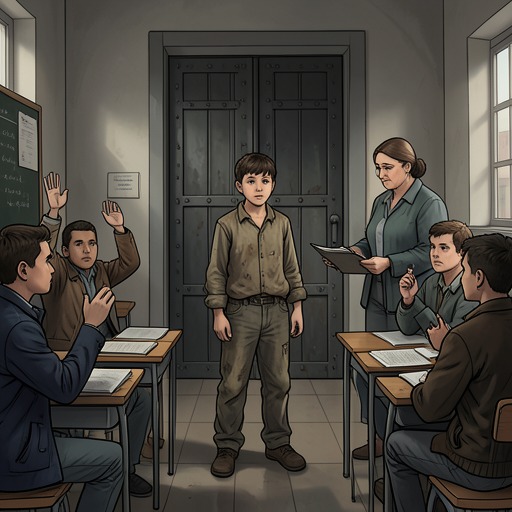
The schoolmaster announces that the boys must prepare for First Confession and First Communion by learning the catechism’s questions and answers. They are expected to become good Catholics, distinguish right from wrong, and be ready to die for the Faith if called upon. The catechism is therefore not presented merely as a reference book: its contents are to be known by heart as part of becoming fit to receive the sacrament.
The material requirement is specific. Each boy must bring threepence for a green-covered First Communion catechism. Older pupils in the fifth class use a thicker, red-covered Confirmation catechism, which costs sixpence. The contrast makes the books visible markers of age and progression through religious instruction; the narrator longs to be old enough to carry the red volume, while doubting that he will live long enough to reach that stage.
Memorization and Discipline
The requirement sits within an extensive program of rote learning. Mr. Benson demands that pupils know the catechism backwards, forwards, and sideways, along with the Ten Commandments, the Seven Virtues, the Seven Sacraments, the Seven Deadly Sins, and a list of prayers. They must recite prayers in both Irish and English. Forgetting an Irish word and substituting English can provoke his anger and punishment, so religious study is enforced through language rules as well as memorization.
Questions are treated as a disruption to this method. When Brendan Quigley asks what sanctifying grace means, Mr. Benson tells him that understanding it is none of his business: the boys are there to learn the catechism and obey, not to ask questions. The episode exposes a tension within the requirement. The catechism supplies answers about faith, but the schoolroom values correct repetition over inquiry into their meaning.
Faith, Ireland, and the Cost of the Lesson
The classroom teaching joins religious and national ideals. Mr. Benson presents martyrdom as the culmination of Catholic faith, while the narrator’s father says it is glorious to die for Ireland. Against these competing demands, the child wonders whether anyone wants the boys to live. His siblings have died, and his parents disagree about the causes: his father says they were too young to die for anything; his mother points to disease, starvation, and his father’s lack of work. The catechism’s language of sacrifice thus meets the material realities of family loss and poverty.
The narrator’s attraction to the red Confirmation book is inseparable from apprehension about that future. He wants to become big and important, yet imagines that he may not live long enough to reach Confirmation under the repeated expectation that he might have to die for the Faith or for Ireland. The requirement consequently registers both as a childhood milestone and as part of a wider culture that makes duty, obedience, and sacrifice familiar before the child can question their cost.
Completion and Significance
The demand for preparation leads toward the sacrament itself. On First Communion day, after arriving at the church as the other boys leave the altar rail, the narrator receives the wafer on his tongue. The brief culmination contrasts with the prolonged classroom process: the memorized instruction is preparation, while the sacrament is the moment toward which that discipline has been directed.
In the account, the catechism requirement links private religious formation to public discipline. Its fixed questions and answers promise instruction in right and wrong, but the classroom’s hostility to questions narrows the space for interpretation. Set beside the children’s deaths and the adults’ arguments about faith, nation, disease, and hunger, the demand to memorize becomes part of a childhood in which religious belonging is taught as both an obligation and a burden.